The products
Built on one boundary
Myelin Live
An app for the neurodivergent and ADHD community: a user-set Friction Dial, micro-steps, a Focus Mode timer, and the Body Double companion for talking, journaling, study, and breaking down complex terms. Runs on-device.
myelin-u1ai.vercel.app →Sentinel & Glass Box Open source
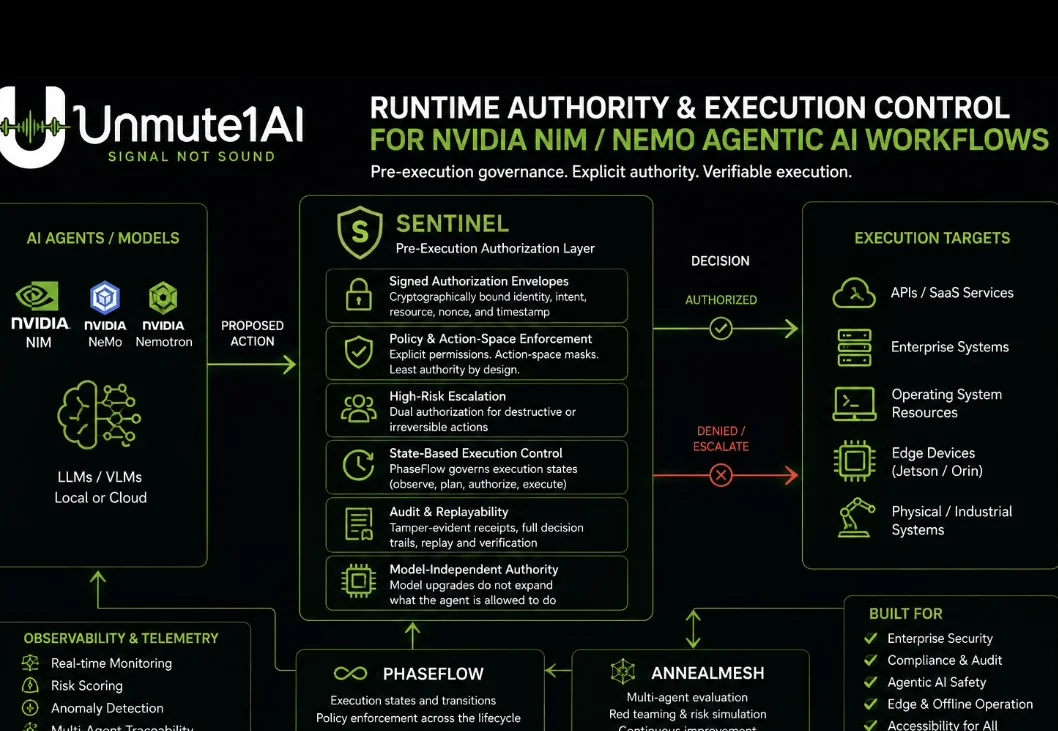
The authority gate for agent actions - ALLOW, REVIEW, or DENY, where a deny cannot be lifted by model confidence - plus the evidence layer that keeps what was said, what was interpreted, and what is proposed distinct.
github.com/Unmute1-Ai/glass-box →Primer In development
A child-first, accessibility-native AI learning environment. Intelligence recommends; authority decides. Success is measured by the child becoming more capable without the AI - not by engagement.
True2u Companion First pass
A neurodivergent companion app. “Make today smaller”: type a messy thought, split it into steps, edit before saving. Early prototype.
Under the glass
How Sentinel decides
Pre-execution governance: a proposed action is checked against signed authorization envelopes, explicit policy, and state-based execution control before anything runs. Authorized actions pass; denied or ambiguous ones escalate to a person.